Posts

Writing Tutors as Car Salesmen

            “Grammar.”   The classic response to the question we ask every writer who comes to the Writing Center:   “So what would you like to work on today?”   Sure, grammar may be a perfectly acceptable response, but how often is it really what the student needs to work on?   Do they even know what they need to work on?   Would they still say grammar if they did?   Such is the dilemma faced by writing tutors, as frequently the issues identified by students are not what they need to work on to improve their writing, and are only what they think they need.   Consequently, how can we as writing tutors be of good service and focus on what the student wants, while actually doing our job of focusing on what the student needs?   Easy – just practice what I consider to be the ‘car salesmen’ approach:   allow the student to tell you what they want to buy, and then convince them to happily...
Gender in the Writing Center: Male and Female Consultant Techniques in OWLs

Piqued by a passing thought as to if our training in the writing center can overcome our impulses, I set out to study if gender played a role in how OWLs were answered at Texas A&M’s University Writing Center. In the field of linguistics, it has been argued that males are more apt to use directive speech and females more apt to use nondirectives; this is largely related to women’s propensity to more polite speech. But, here we have training that being directive is largely not our first instinct as tutors. How did this interact with gender impulses?   I gathered 30 male and 30 female OWL responses submitted over a five-year period and constructed the following study to answer three research questions: 1.       Does gender affect the use of directives and nondirectives? 2.       Does gender affect the delivery technique of suggestions (politeness, evaluation, explanation, and options)? 3.     ...

Teaching Revision with Digital Collation Software

Image
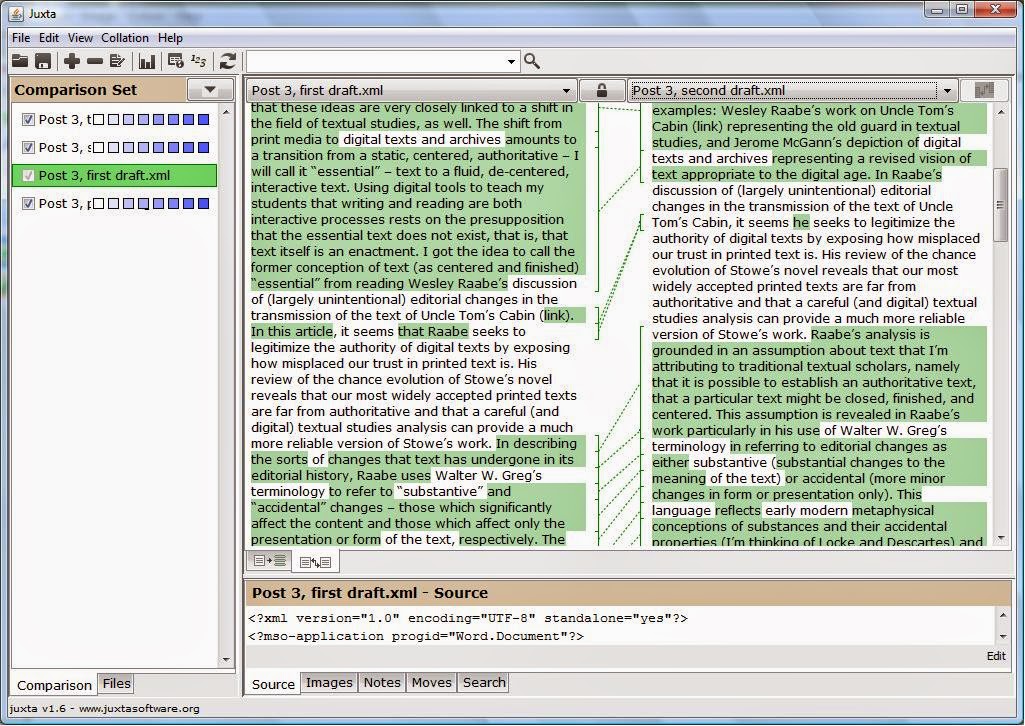
There’s this collation tool online called Juxta . It allows you to compare two documents, and it highlights the differences between them in at least two ways. First, it shows both documents side by side, highlighting differences and drawing diagonal lines showing how pieces of the text have shifted. Second, it creates a heat map on just a single document, showing by lighter and darker shades of highlighting how different this document is from the other(s). Now, a tool like this is meant for scholars in literary and textual studies; for example, one who is interested in determining whether the edition of Whitman’s Leaves of Grass available through Google Books matches the copy in her local library. (Whitman was a compulsive reviser, and digital reproductions of pre-1900 texts are notoriously mismanaged. So this scholar could find some interesting results!) But I propose another use for collation software like Juxta: it can be used to learn about revision. Instead of comparing ...

More Creative Writing Solutions

           As mentioned in my previous blog, I teamed up with a fellow creative writer and tutor to explore ways to help fellow tutors consult on creative writing. We began the project this spring and presented our training session to our fellow tutors in October. In this blog, I will detail our presentation and results. In “Is There a Creative Writer in the House?” Wendy Bishop discusses the benefit of working with different types of writing. “By analyzing the styles of writing you encounter in the world you’ll become a more proficient brainstormer and adviser to your clients on the options available to them…. Then, put all these bits of advice in service of helping the writers you work with interrogate convention and experimentation as tandem parts of the writing process.” Essentially, we need all different types of writing and we can take many of the lessons we learn from one field to another. Our presentation focused on one main...

Creative Solutions to Creative Writing in Writing Centers

Writing Centers strive to excel at consulting with every type of writing from business and scientific writing to English papers. However, many writing tutors struggle with consulting on creative writing. Many fear the creative writers and have dozens of questions and worries about a creative session. “How can I critique a piece like this?” “This has no rules or standard templates to work from. How can I give advice on what’s right or wrong?” “This isn’t my field and I have no knowledge of literary devices or how to critique creative writing.” “My fallback is always grammar and obviously the creative writer doesn’t need help with that area because they write all the time. They know this stuff.” “Who am I to judge their piece?” Hans Ostrom discusses the uneasiness with creative writing in his article “Tutoring Creative Writers: Working One-to-One on Prose and Poetry.” He discusses how peer tutors are not alone in this uneasiness. He says, “… there are all sorts of literary experts i...

Thoughts while doing a research project

If there is something to be careful about when handling a research project, it is to be wary of assumptions. I have found that during the course of my project, whereby I am studying why students procrastinate on writing assignments, there are many different factors and opinions that come into play. While unifying these different factors and looking for commonalities, I feel like even with all the background literature I have read, a lot of the conclusions and inferences I have been drawing, may be considered subjective in some light. I fear that if someone with a completely different mindset were to be exposed to all the literature I have been exposed to, and all the gathered raw data I have gathered, they might come to a different conclusion than I for the same question I am asking. I am trying to be extremely careful as to include all possibilities in my conclusions and to gear towards what is most likely, but there is just this overhanging fear that unless I actually test my data a...

Working With Student-Athletes

I have heard several writing assistants complain about working with student athletes. The main complaints are basically that student-athletes come to the tutoring center unprepared, with mediocre and incomplete assignments, and with a care-less attitude. Many tutors feel frustrated working with student-athletes because tutors feel like student-athletes are not interested in learning and actually improving their writing skills. And if the student-athletes themselves don’t care about their grade, why should we, the tutors, care? Many tutors feel unenthusiastic about working with student athletes because of the belief that the session will be tedious and that they will be basically talking to a wall for 30 minutes. However, this is a misconception, and tutors should give student-athletes a chance before stereotyping them as poor writers. Athletes, in fact, are extremely smart. They have leadership skills, strong teamwork values, and they enjoy challenges and competition. Addit...

Breaking tradition

When I said I wanted to write something about being a nontraditional student, a fellow tutor asked, insightfully, what the term actually meant.   So I looked it up. According to our school’s website: “ A non-traditional student [includes] any of the following: over age 25, married or partnered, having children, a veteran of a branch of the Armed Services, a student who works full-time, or a student who is enrolled part-time .”   Most nontraditional students started reading this like a checklist, not an “or” statement.   25, check.   Married, check. Veteran, check plus.   It’s almost a game of   “do I fit more categories than you?”   I probably do, by the way.   I fit all except the last two, which usually come as a set, so I think they should be one item.   Think about that, though.   When the school goes to offer services to groups of students, “nontraditionals” tend to count as one lump category, but a 22 year old mother, work...