Posts

How To Handle Rhetorical Punctuation Issues?

As I've been tutoring for the past year, I keep coming across an issue that I haven't heard talked about a whole lot--I'd really appreciate feedback on how everyone handles this situation, and (if it applies) what your thoughts are on how it might be handled better. Pointers to any literature on the subject would be awesome too. The enclosed link is just an article from The Wall Street Journal that I thought was interesting--it got me thinking again about the question I've been wanting to pose to other tutors since this summer. Love to hear what your perspective is on the article too, but let me get on with my question. Our writing center sees students from every major and I tutor every undergrad class level. The more I tutor, the more I notice that grammar and punctuation are very rhetorical: in many ways professors' perspectives of  "what is correct" are all different--many times dependent upon their field. For instance, Engineering professors (in my...
Survey on plagiarism

This just in from Zuzana Tomas: Dear tutors/consultants, I am working on a study that examines your experience with and beliefs about writing from sources and plagiarism. I would greatly appreciate it if you could participate in the study by completing an online survey. The survey is completely anonymous and should not take longer than 15 minutes to complete. Here is the link to the survey: https://www.surveymonkey.com/s/PBMQCRM If you would like more information about the study, please do not hesitate to contact me. Thank you so much for your help! Zuzana Tomas ( ztomas@emich.edu ) Eastern Michigan University

NCPTW Conference tips

On WCENTER, Risa Gorelick posted some handy tips that the WPA email list sends out that might help first-time NCPTW attendees (edited with peer tutors in mind): General First Time Conference Attendees: wear comfortable shoes! network with EVERYONE.  Meet new people.  Stay hydrated.  Conference hotels are dry and you'll talk a lot. Bring snacks (Powerbars, candies, etc.) in case you're in a session during lunch. Go to the parties (don't sit in your hotel room...).  Try to  go to a session on something you don't know much about rather than go to all the sessions on [subjects you know something about].  You'll meet new people and learn something to boot. Try not to go up to some big name and say, "wow, you're so-and-so" (s/he will know that already).  Instead, introduce yourself and start a conversation.  [Don't be afraid to talk to people, in other words!] It's OK to go up t...

PeerCentered Podcast! NCPTW 2011 Preview: Daniel Sanford

NCPTW 2011 Preview: Daniel Sanford Daniel Sanford from the University of New Mexico talks about his upcoming presentation at the National Conference on Peer Tutoring in Writing: "Writing Tutoring and Language Rights: Spanish and Navajo Writing Tutoring at the University of New Mexico."

PeerCentered FlashMob 3.0

Image
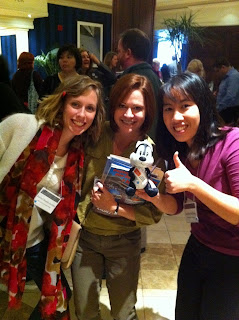
PeerCentered Flash Mob 2.0 in Baltimore Come join PeerCentered colleagues attending the upcoming NCPTW conference in Miami in a flash mob & get an official PeerCentered sticker for your name badge! The plan is to meet up at the Pizza Reception/Poster Session on Friday at 5:00. You can dance if you want to, but if you don't dance and if they don't dance, well they're still friends of PeerCentered. As at the last PeerCentered FlashMob [TM] we will be trading erstwhile mascots. Bring your stuffed animals/tin Elvises/whatever to trade with other PCFlashMobbers. Last year, for example, the SLCC Student Writing Center traded its fake Pepe Le Peu plush animal for a rather fetching tin angel Elvis. This is the third PeerCentered flash mob. Our first was held at the 2008 Las Vegas NCPTW/IWCA joint conference. The second was in November 2010 in again at the IWCA/NCPTW Joined Conference. This is our first with just an NCPTW mob!

Fall semester here we come!

Here we are at the start of another school year. Here is an idea to get your PeerCentered juices flowing: post a comment to this post about something you would like to improve on in your tutoring writing.

Writing Center Haiku Project

I encourage everyone to check out and submit to my project.

Praxis publication and news

This just in from the editors of Praxis: Praxis, the writing center journal at The University of Texas at Austin is happy to announce the publication of its Fall 2011 issue, From Triage to Outreach: Raising the Institutional Profile of Writing-Center Work. Please find our latest issue online at the Praxis website: http://projects.uwc.utexas.edu/praxis/ . Beginning this spring, Praxis will be published as a peer-reviewed journal. Our Spring 2011 issue is the second in a series about the institutional profile of writing centers and writing center practice. Please see our Call for Papers at http://projects.uwc.utexas.edu/praxis/?q=node/364 . Our guidelines for submissions have changed. Those interested in submitting aritcles for peer review, column essays, and book or conference reviews can find our new guidelines for submission at http://projects.uwc.utexas.edu/praxis/?q=node/14 . The deadline for submissions is August 20, 2011.

Electrical Tape Was Our Bond

Hey Friends~ My name is Angie, I'm a English Writing Major at Montana State University, where I also tutor in our Writing Center. I'm new to the tutoring community, but I've fallen in love with it already and am trying to get more familiar with writing center research, culture, jargon, conferences--ya know, everything! This blog has been really helpful for me just to hear the kinds of conversations peer tutors in other places are having. Thanks! My last day of tutoring for the semester made me think about things I'm not sure I've thought this deeply about before. Like how easy it is to profile a writer by the appearance of their paper and how this can jade our opinions of the paper and the writer before we even read, causing us to miss out on powerful teaching/learning moments. And also how there are many ways we can connect with a writer; some of them so obvious that I, for one, didn't even see them until my interaction with this student opened my eyes. Like...

Crossing the Age Gap with Adult Learners

Working with adults returning to school for either their bachelor’s or graduate degrees has helped me develop my skills as a consultant and peer tutor. Consultations with adult students have a different atmosphere about them than do traditional, young students; they are usually able to better articulate their problems and explain their concerns. When the age difference is significant enough, challenges can inhibit the client gaining trust in the tutor. To overcome them, we have to look at different ways of thinking about what being a peer tutor means. The broadest definition of “peer” is someone who belongs in the same group as you, and most commonly this refers to age. Peers can just as easily be people with similar abilities, qualifications, and other statuses, but age is the first impression. Most of the consultants at our Writing Center and the students who come in are undergraduates and graduate students within the same age range. Before any words are exchanged, this automatically...

2011 NCPTW Conference

The National Conference on Peer Tutoring in Writing will take place November 4-6 in Florida International University's Biscayne Bay campus. Since the deadline is right around the corner (April 25), I wanted to know if anyone is planning on attending. If so, what are you thinking about presenting?

Facebook: The Writing Center

Image
At the 2011 Rocky Mountain Peer Tutoring Conferece hosted by Westminster College in Salt Lake City, Joe McCormick, Writing Advisor at the Salt Lake Community College Student Writing Center, presented his work on incorporating Facebook as a writing center platform, including standard information and writing-related resources as well as online tutoring.

Revenge of the Podcast

After a couple of years of on-again, off-again quest for a new server home, the PeerCentered Podcast is back!  There are some "episodes" from the last couple of years that were placed in other venues and represented here in the PeerCentered blog. If you are interested in doing a podcast episode, contact me (Clint Gardner.)

Steps to Success: Examining the Effectiveness of Follow-up Consultations

It started as any other consultation with a graduate student. I met the student, Kevin, and discovered that he wanted help with his journal article. He had been to the University Writing Center (UWC) once before a few months ago, so he had an idea of the kind of work we do. His concerns centered mostly on article use and the structure of sentences. I was also able to identify comma use errors and some capitalization issues when naming proper nouns. Overall, Kevin was eager to learn. It seemed more important to him to really understand the underlying concepts we discussed rather than just covering as much ground as possible. This was my first hint that perhaps this client could benefit from a more long-term consultative relationship. As we neared the end of the session, Kevin mentioned that he was very happy with the feedback I was giving him and wanted to know if he could meet with me again. I was about to give him the normal line about how everyone is just as qualified – which they ab...

Question for Everyone

So lately I've had a question on my mind and want to share it with all of you to see the responses I get. I know there have was a presentation or two on the subject during the IWCA-NCPTW conference,but here goes: What happens to the identity of a tutor when they are no longer a tutor? Many times, tutors have an identity that they have developed while tutoring. What happens when the tutor is no longer a tutor, but just a student? How do they adapt, per say? I find myself asking this question more since I tutored as an undergraduate, but do not have the time to tutor as a graduate student. Your responses who be helpful for an article I am writing.

What's in a name?

A few years back, the PeerCentered podcast took a video recorder to the Rocky Mountain Peer Tutoring Conference at Weber State University.  One of the projects was to ask attendees what their job was called (given that there seems to be a lot of contention about how writing center work and workers should be labeled.)

The Revenge of the Podcast

The server that the PeerCentered podcast was on crashed and is unlikely to return.  I'm looking into options for the podcast and whether or not to continue it at all.  If you are interested in developing podcast episodes for PeerCentered, let me know.

A winner!

Image
Recently at the 2010 National Council of Teachers of English Convention International Writing Centers Special Interest group Denise Calix, PeerCentered blogger won a giant gummy bear: Congratulations, Denise!

Peace of Mind in the Writing Center: Putting the Client at Ease

Having a writing center tutor read your work can be as stressful for a client as having an instructor read it for a grade. Even though a tutor is not grading the work, the client is worried about being critiqued. He will likely be worried that the errors will be so numerous that the tutor might not verbalize it, but will think about what a terrible writer he is. Even I have had these fears almost every time I have had someone look over a paper which I have written. The client may even fear that the tutor will think that he is the worst writer the tutor has ever seen, or read. Since the tutor's role is not to grade the writings but rather to hep the client become a better writer, easing the client's fears is a particular challenge for the writing center tutor. This is especially important since helping the client to become a better writer means, in part, helping him to become a more comfortable, confident writer. Putting the client at ease begins at the very onset of the sess...

Creating Effective Tutoring Atmosphere

Writing is a very personal undertaking to the extent that most writers would pass the chance to attend a tutoring session, unless it is absolutely necessary.   The challenge for tutors in this environment is to find a balance between reinforcing the writer’s self-esteem while ensuring that the essential issues are addressed. If you read a bad paper, how could you bring the writer to understand this without making him/her feel terrible about the whole tutoring concept? It is a real challenge to deliver bad news; personally it is even harder and I am sure most of you would agree. To overcome this rather uncomfortable situation, I often commend my writers for a good paper and use personal writing challenges as a basis to underscore the troubling spots in their paper. Mind you, commendations are sometimes ineffective because writers know when they have done less than perfect work.   So while it is necessary, it must be aimed at honestly evaluating the writer for a fair attempt. I ...

A Really Long Blog I've Been Too Scared to Post Since Thursday

Recently, I found out that I have an intense fear of sharing my writing with a large audience. I realized this when I started to write this blog post for PeerCentered. As I began writing, I felt a sense of fear, which I managed to trace back to the fact that I was writing something that I knew would be presented to a large audience over the internet. This blog post, which I feel has yielded some good results, actually started as a breakdown of the reasons why I was so uncomfortable writing a blog entry that would be read by people I didn't know. Only after writing for awhile did I realize that what I had been writing had a larger application than letting me know what I was scared of. The reasons that I dislike sharing my writing at times are the same as some of the reasons that others may feel some trepidation over presenting their work. I decided to adapt my own personal breakdown into something that I feel can help consultants in the writing center crack people who don...

Preparing for Writing Fellows

At The Studio, we have a program called Writing Fellows. How the program works is that each consultant who participates is assigned a group of students from a class. From our assigned class, we're given a group of students and we then look over the students' papers and give them written feedback in letter format. After the students have been given time to look over the written feedback, we offer the students a face to face consultation with their fellow. This week will my second time working with the Fellows program. The first round of fellows went pretty rough for me but I think we're successfully ironing out the problems and making progress with the process. Although, the whole process of Writing fellows can be stressful at times, I find the the whole experience extremely beneficial and rewarding as a consultant and as a student. The main reason why I find Writing Fellows so rewarding is the written feedback. I've found a love with written feedback because it gives me...

Video Consultations

Here at The Studio, Illinois Central College's writing lab, we have an end of the semester assessment assignment to understand and document our growth throughout the semester. Seeing as most of us, who aren't faculty, have only been consulting since the beginning of the semester in late August, this is a great way to discover how we problem solve and truly interact with our peer writers. The goal is to video tape yourself, however many times you feel is necessary, and watch them. You proceed to take important notes on: strategies you use, specific word choices, body language of both parties, and how well you helped them out as a writer instead of simply modifying the paper. I managed to take two video consultations this past Wednesday, one was a full 30 minute consultation. The other video died after seventeen minutes of video. I haven't had the opportunity to watch them quite yet, but I am interested to see how I consult from a third party standpoint. Of course to help ass...

Confidence

What’s one of the hardest parts of being a writing consultant? Well, for me, and I’m sure many others, the hardest part is being confident in your consulting skills and in what information you are passing on to the writer in need. I have been working in the writing center at Illinois Central College for almost a whole semester now, and my lack of confidence in what I am doing is what has tripped me up the most. This lack of confidence keeps me from doing my best as a consultant, which leads to desperate writers not getting the help they need and deserve. For this reason, I have decided to give some tips on boosting confidence, so that other consultants or tutors that are suffering from this same problem can maybe benefit from them Tip #1: Before entering into a consultation, take a deep breath and just look at the person you are going to be working with; that is all they are in fact: a person. They are not a ravenous lion. They are not an angry snake. They are not a wasp that will stin...

Make a Connection

What I have found extremely beneficial to my growing as a student consultant is learning how to greet the student when they first enter for their consultation. I think this step can sometimes get overlooked in the hustle and bustle of getting everything in order to begin the consultation. And I know for me initially, it was easy to start concentrating on how the flow of the consultation would go that I would set myself and the student up for a bumpy ride. But to me this initial communication step is the first, and usually most crucial, step. And learning this has been a real eye opener for me because I find myself focusing more on making the student feel more comfortable and welcome when they first enter than I did when I first began working as a consultant. And I have found that by doing so, the rest of the consultation flows quite smoothly and the student seems to be more open to speaking up and communicating with me. I just find it fascinating how such a seemingly small part of the...

Letting the Student Practice

One of the things we emphasize here at The Studio is equipping the students in our consultations with tools to help them be able to apply what they've learned in the consultation to other papers they have to write. To achieve that end, we try to get the student involved during the consultation. We have them practice what we've gone over. Finding ways to let the student practice in my consultations takes practice, pun intended. However, letting the student practice has many benefits, two of which are that you know that the student understand what you are saying and that the student can apply what she/he has learned to other essays. Take, for example, a student with an essay that has no thesis statement. You explain to the student what a thesis statement is and why it's important. The student is nodding politely the whole time, replying with an emphatic nod whenever you ask "Do you understand?" How do you know for sure that the student actually understands wh...

The Planning Stage

This week I have been spending a lot of extra time here in the Studio, and because of this I have been able to observe several of my fellow consultants at work. While I have seen many good things at work here, I have also noted a vital step that seems to be missing in nearly every consultation I have seen-- the planning step. For those of you who do not know what the planning step is, let me enlighten you. The planing step is a vital step in the Anatomy of an Effective Consultation. In this step the consultant is to ask the writer what she or he wants to work on with the time remaining, giving some guidance. An example of this would be: "Alright Ben, we have about twenty minutes left. That gives us enough time to tackle two of the issues I have noted. Which would you like to tackle first?" This stage is important because it is a necessary tool to help the student lead the way. I think that often times it becomes too easy to take the reins of the consultation, and we dri...

Andrea Lunsford talks technology

In her keynote address to the 2010 National Conference on Peer Tutoring in Writing/International Writing Centers Association Conference, Andrea Lunsford discussed the perils of technology and the challenge that it places on writing centers.

Jenny talks about the benefits of being a high school peer writing tutor

At the 2010 National Conference on Peer Tutoring in Writing/International Writing Centers association joint conference in Baltimore, Maryland, Jenny talked with me about benefits of peer tutoring during the Scholar to Scholar session Brandon Alva and I presented.

The Hidden Lesson

Several aspects of a writing consultation involve isolation. We isolate ourselves in where we tutor- shutting ourselves into tiny carrels with just the client. We isolate aspects of papers that need work, while disregarding things that might be only considered “acceptable.” We isolate subjects and style guides and types of writing, without thinking how all types of writing are equally important. Mostly, though, tutors often forget about the emotional needs and wants of the client. We forget that while we have done the tutoring process over and over before with all types of people, many “first-timers” may feel isolated and nervous in their first session. My most vivid memory of this incident is with a client I had from Panama. His name was Ricardo and he was a freshman who had transferred during the spring semester. He came in with a lot of confidence about whom he was as a person, but still seemed very nervous about the contents of his paper. I could tell he was rather anxious, so I to...